
Golang in China
Why many Chinese developers use Go to build services

I like looking for patterns and then trying to find explanations for them. Even better when patterns are so obvious that they don’t need to be looked for, ones that pop right into view and demand attention in their way.
One example is the uptake the Go language has in China.
In global markets, Go is fairly niche, but still significant and respected. In Feb 2026, it was ranked 16th on the TIOBE index of the most popular languages, which is “based on the number of skilled engineers world-wide, courses and third party vendors”. Packt has a decent-sized Go catalogue, containing long-running franchises such as Mastering Go and standalones like the very recent Mastering Go for DevOps. Other Go content, for example from O’Reilly, has focused on concurrency, performance, reliability, and cloud-native development.

Curiously, Go was the first programming language I tried to learn; I remember messing around with Hello Worlds and Fizz Buzzes (Fizzes Buzz?) inside its Playground, and hearing the friend who introduced me natter away about generics. I found the gopher endearing and a little kitsch at the same time.
In the first month I started speaking to Chinese developers, I was exposed to Excelize, an indie open-source library for spreadsheet automation, and Eino ADK, a ByteDance open-sourced multi-agent framework, both written in Go. In internet research and subsequent conversations, I would make mental notes like, “Oh, there’s Go cropping up again.” The ByteDance brand name should’ve been the first clue that the language was circulating in large enterprises.
In 2015, Robert Griesemer went to the first Go conference in China and blogged about it. He cited that, by Google Trends, “golang” was more searched in China than anywhere else in the world, and that people disagreed about what that meant. Herman Schaaf had dug a little deeper the previous year. I am quite late to the party, but at least I’ve turned up.
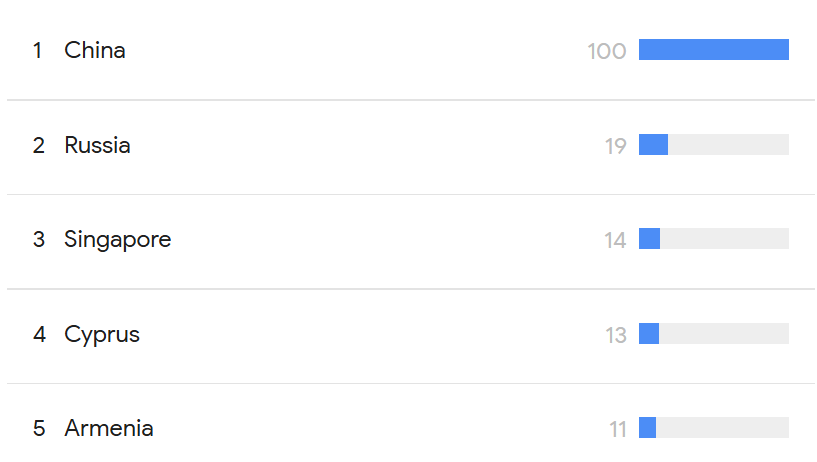
At the Go conference, Griesemer observed (emphasis mine):
“…many of the presentations were about web services, backends for mobile applications, and so on.
“Some of the systems appear to be huge by any measure. For instance, a talk by Yang Zhou described a large-scale internal messaging system, used by Qihoo 360, a major Chinese software firm, all written in Go.”
He wrote that, in China, Go seemed to be used at a scale not seen anywhere else.
At the start of 2018, Andrew Bonventre announced that content on the official Go website would be available to mainland China through a .cn domain, and name-dropped a few more big orgs known to be using the language:
“Go adoption within China-based companies has also increased, with Qiniu1, Huawei, Alibaba, and countless others using Go heavily in their production stacks.”
Tellingly, Go was only released at the tail end of 2009, and Google moved its search operations out of China at the beginning of 2010. Redditor gophercn offers a 2010-2014 timeline for Go in China that captures strong community efforts, complementary IDE and framework releases, and also Qiniu’s adoption.
The language clearly has staying power and it is only natural to ask why. Ri Xu, the creator of Excelize, explained to me his rationale for choosing Go for his library back in 2015 (emphasis mine):
“…after evaluating and comparing the options, I became convinced that using Go would be the best fit for modern internet applications that demand high performance and rapid iteration.
“Go strikes an excellent balance between development efficiency and performance. Its well-designed toolchain and rich standard library greatly improve productivity.
“In addition, Go makes cross-compilation remarkably easy, which simplifies supporting multiple platforms.”
I’ve seen that Chinese engineering culture emphasises pragmatism, as well as being hit over the head by commentary saying similar. A Chinese developer will get the job done and choose a good tool for doing it. Devs I have spoken to don’t seem attached to languages or ecosystems; many talk in terms of outcome, efficiency, and keeping up (obligatory nod to involution). I’ve been advised to look at prompting, fine-tuning, and AI pipelines as areas where Chinese AI expertise shines; these are all firmly implementation-level concerns. This aligns nicely with an FAQ on the official Go site that describes why the language was created (emphasis mine):
An overarching goal was that Go do more to help the working programmer by enabling tooling, automating mundane tasks such as code formatting, and removing obstacles to working on large code bases.
After a modest five years in tech publishing, I’m learning things about the Chinese ecosystem that have been true for three times as long. A half-excuse is that some of China’s tech stacks are different — the big tech footprint is completely divorced from the Microsoft-Google-etc. reality here, for one — but ultimately there are still many, many similarities, and open-source GitHub data is there for all to see…
Qiniu is much smaller than the hyperscale Huawei and Alibaba, though still a publicly listed cloud vendor.